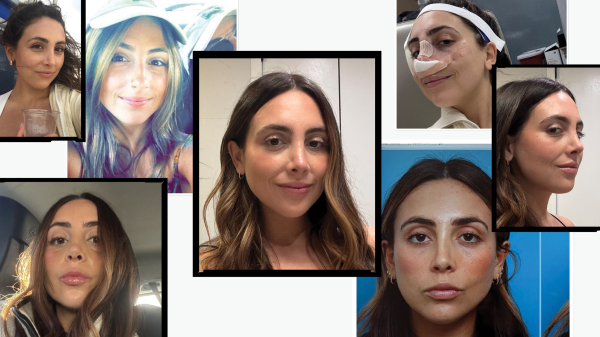
 Courtesy Victoria OlivaSave this storySave this story
Many people celebrate their college graduation with a party, a family trip, or a special keepsake—maybe an investment bag or a piece of jewelry. I got a rhinoplasty.
Some context: I'd always liked my facial features, but as I got older, a bump on the bridge of my nose became more and more prominent. As it grew more apparent, I grew increasingly insecure about it, to the point that it consumed me. I hate to admit it, but I'd spend an ungodly amount of time in front of the mirror: fixating on the hump on my nose and experimenting with makeup techniques that would soften its appearance. In photos, I'd smile with a closed mouth, because a smile too wide would only accentuate the “imperfection.” I'd compare my nose to my sisters' perfect, pert, straight ones, wondering how I ended up with this asymmetrical appendage.
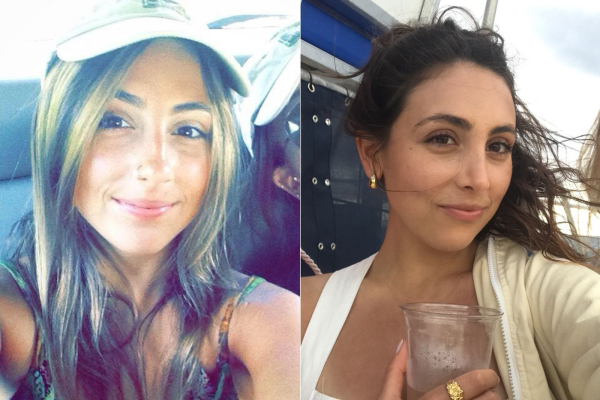
L: The writer at 21, before her first rhinoplasty. R: One year after her first rhinoplasty.
Courtesy Victoria Oliva
So with the ink on my diploma just barely dry, I went into the OR for a rhinoplasty, performed by a plastic surgeon in my home state of New Jersey who came recommended by a family friend. After reducing the bump on the bridge of my nose and refining the tip, I was happy with the results and my confidence definitely improved—for a time.
Why I Started Considering a Second Surgery
Fast forward a decade later, and my rhinoplasty was not aging well. Although my bridge remained smoother, I was left with one side of my nose collapsed, a droopy tip, and even breathing difficulties—my nasal passages always felt kind of clogged. With each year that passed, I felt like my nose was becoming more crooked.
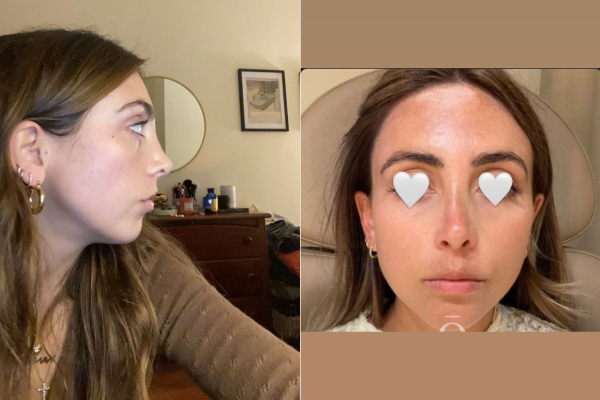
L: Two years after her primary rhinoplasty. R: Nine years after.
Courtesy Victoria Oliva
This kind of gradual change is more common than most people realize. The surgeon who ultimately did my revision, Thomas Romo III, MD, a double board-certified facial plastic surgeon and director of facial plastic and reconstructive surgery at both Lenox Hill Hospital and Manhattan Eye, Ear & Throat Hospital in New York City, explains that healing after rhinoplasty is highly variable. While the nose is generally considered healed around the one-year mark, that timeline can stretch to 18 months or longer depending on the person.
Rhinoplasty is one of the most technically demanding procedures in plastic surgery. As Allure contributor Joan Kron wrote 20 years ago in a story about rhinoplasties: “The surgeon must mold skin, cartilage, and bone into a suitable shape strong enough to allow a 50-mile-per-hour flow of air.” (Achoo!) And revision cases take the challenge up several notches. Each surgery disrupts blood supply to the skin and lays down a new layer of scar tissue, meaning the risks compound with every procedure. Unlike procedures on the body where tissue is more forgiving, incisions are more accessible, and the architecture is less intricate, the nose is a complex, multilayered structure of skin, cartilage, and bone packed into a very small space. Every millimeter matters. And because this particular body part sits at the center of the face, even subtle irregularities are visible.
Although I hated the thought of putting my body through another surgery (and facing the emotional and physical challenges that come with it), I knew I wanted to explore a second rhinoplasty. Not only for aesthetic reasons—which admittedly held a lot of weight in my decision—but because it was becoming more and more challenging to breathe freely. I was concerned about the condition worsening, so I started looking into surgeons.
Finding a Revision Rhinoplasty Surgeon
One of the perks of living in New York City is having access to an overwhelming number of world-class plastic surgeons. I met with at least 10 of them for consults. I went into the process knowing it wasn't a pick-the-biggest-name-and-hope-for-the-best situation. I didn’t need someone who just does great nose jobs, I needed someone who excels at revisions. "When I approach a revision rhinoplasty, I'm not starting with a blank canvas,” Sam Rizk, MD, a double board-certified facial plastic surgeon based in New York City, says. “I'm working with a nose that has already been surgically altered."
Unlike a primary procedure, where the anatomy is intact and predictable, revision surgery requires a careful analysis of what remains: the condition of the septum, the strength of the nasal valves, the thickness of the skin, and how the nose has healed from prior surgery. Scar tissue, compromised support structures, and over-resected cartilage are all common findings. "The goal is not just to refine the appearance," Dr. Rizk explains, "but to restore structural integrity and function first." That's why finding a surgeon with deep experience in revisions specifically, not just rhinoplasty broadly, matters so much—the calculus isn't just about what's aesthetically possible, it's about what's safe. On top of the usual risks that come with surgery, a botched revision can mean permanent scarring, loss of nasal support, worsened breathing, or a result that's structurally too compromised to correct again.
Unlike a primary procedure, where the anatomy is intact and predictable, revision surgery requires a careful analysis of what remains.
While the other surgeons I spoke with were reputable and talented, when I met Dr. Romo I knew immediately that he was the right choice for me. He was direct and transparent, but never pushy. He didn't try to impose his aesthetic or talk me into a version of my face that wasn't mine. It felt collaborative, like he was listening to what I wanted and then calmly explaining what was realistic, what was unnecessary, and what would keep things structurally sound long-term.
Over the month-long for a surgeon, I didn't let social media hype sway me—someone can have a huge TikTok following, but that doesn't tell you about their actual surgical outcomes or experience with complex revisions. Before-and-afters, on the other hand, can tell you a lot. Ask every surgeon you consult for a portfolio of revision cases specifically—not just primary rhinoplasties—and look critically at what you're seeing. Lighting, angles, and timing can all be manipulated to make results appear more dramatic than they are. (Read Allure’s full guide to spotting misleading post-op photos.)
Revision Rhinoplasty, Explained
Revision rhinoplasties are much more common than most patients realize going into their first surgery. Both Dr. Romo and Dr. Rizk specialize in the procedure, so they do more revisions than the average surgeon, but Dr. Rizk estimates that 10 to 20 percent of patients who undergo a primary rhinoplasty will eventually consider a secondary procedure. On timing, both surgeons are aligned: waiting at least a full year after the initial procedure is critical. The nose needs time to heal completely, and only once swelling has fully resolved can a surgeon properly assess what needs to be addressed.
In our consultation, Dr. Romo explained that for decades, rhinoplasty was largely about subtraction, or making the nose smaller by removing structure. The problem, he noted, is that taking too much away can compromise breathing and leave the nose to heal unpredictably, resulting in deformities, twisted profiles, and that telltale over-scooped look. The field has since course corrected. “Structured rhinoplasty” is the current standard among plastic surgeons, and it focuses on building and reinforcing the nose's internal framework, using grafts to create lasting support.
For those who already underwent a subtraction-focused procedure, restoring that lost structure is exactly as involved as it sounds. "In revision cases, rebuilding the structure usually means that too much cartilage was removed during a prior surgery, or that the nose's foundational support has been weakened," Dr. Rizk explains. "This can create both aesthetic concerns [like drooping, a collapsed tip, and asymmetry] and functional problems, including difficulty breathing." Reconstruction means restoring that internal framework with cartilage grafts. In his practice, the most common material he uses is rib cartilage from a tissue bank, which is particularly effective for more extensive structural work. "These grafts serve as the nose's internal scaffolding," he says. "They allow me to rebuild the bridge, support the tip, and improve airflow, while also creating a result that looks natural." In my case, Dr. Romo used cartilage from my ear (more on that in a bit), placing small, precisely measured grafts to rebuild the collapsed areas and restore both structure and symmetry.
Needing a revision doesn’t necessarily mean the surgeon for your primary did a bad job. Dr. Romo says that it’s usually a combination of factors that leave a patient unsatisfied with their rhinoplasty in the long run. Skin texture, for example, plays a big role: Patients with thinner skin—whether due to genetics, age, or the cumulative effects of sun damage and collagen loss—are more likely to see asymmetries emerge over time, since their skin can reveal every contour underneath. But in most of the revision cases he sees (including mine) the primary culprit is technical: If too much architecture has been removed, it leaves the underlying structure too weak to hold its shape as the skin heals and contracts around it. "The skin is not benign," he explains. "When it heals down to the architecture, it has a tensile force [the skin's natural pulling/contracting force as it heals and adheres to the underlying structure] and if the architecture underneath is weak, it'll deform, leaving a dent, a bump, or an asymmetry."
For a revision to be successful, the approach has to be both precise and selective. Dr. Rizk is straightforward about this: Every subsequent surgery is more complex than the last; scar tissue builds up, the underlying structure may already be weakened, and there's less margin for error. But when the focus is on rebuilding from the inside out rather than just refining the outside, most patients don't need to go back for another procedure. He's also selective about who he operates on, turning away roughly 20 percent of prospective patients and only moving forward when he's confident that a real, lasting improvement is possible. If scar tissue is too severe, if prior surgeries have left the blood supply compromised, or if a patient's goals aren't achievable without unacceptable risk, proceeding could cause irreversible damage. That kind of judgment, he says, is what makes the difference long-term.
The Cost of Revision Rhinoplasty
According to the American Society of Plastic Surgeons, the average cost of a primary rhinoplasty in the U.S. is $7,637, though that figure can vary greatly depending on your geographic location and provider. Second rhinoplasties are typically much more expensive—and the more complex the case, the higher the cost.
In New York City, Dr. Romo estimates the range for a revision runs roughly $20,000 to $50,000, though highly complex reconstructions can cost significantly more. For context, my own procedure came to $24,600 total — $20,000 for the surgeon's fee, $2,400 for the facility, and $2,200 for anesthesia. It's also worth budgeting for consultations: I'd recommend speaking with several surgeons before committing (though 10 might have been overkill!), and each appointment can cost anywhere from $500 to $2,000, though the surgeon you ultimately proceed with will typically apply that fee toward your final bill.
The reason is straightforward: revision cases simply take longer. Where a primary rhinoplasty might take under an hour, a complicated revision can run five, six, even seven hours in the operating room—and that time, expertise, and precision are reflected in the cost. You also have to consider anesthesia and surgical facility fees, which are typically billed separately from the surgeon's fee. Anesthesia alone can range from around $1,500 to $3,500 for general, and facility fees vary depending on whether the surgery is performed at a hospital or a private surgical center, with hospital fees typically running higher. Most reputable surgeons will provide an all-in quote after a consultation so there are no surprises.
My Revision Rhinoplasty Game Plan
Dr. Romo says that he looks at the nose like an arch. In the case of my particular arch, "Your upper width has collapsed and it affects all three thirds of your nose: upper, middle and lower,” he told me. “Those areas need to be augmented." To do that, he would rebuild with small pieces of cartilage from my own body placed strategically to restore the structure of my nose, not only immediately but long-term. The surgery would involve very precise work, measured in millimeters. The goal was to keep my nose small and slightly upturned, but better balanced and more refined. What gave me confidence was his measured approach: He was intentionally keeping the plan conservative since I liked my nose shape overall. We would just be improving specific issues rather than doing a huge reconstruction.
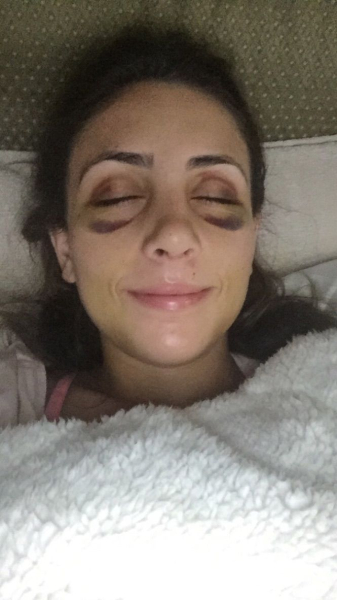
One week after the primary rhinoplasty. The bruising was much worse with this procedure than the revision.
Courtesy Victoria Oliva
In my case, Dr. Romo assured me the downtime wouldn't be dramatically different from a primary rhinoplasty—which is the case for most revision rhinoplasty patients. The critical window is the first two weeks. You might be most focused on how you look—swollen, bruised, potentially sporting two black eyes. But what’s really important during this time period is avoiding anything that could cause bleeding or raise your blood pressure (downward-facing dog, heavy lifting). Once you're past that point, the risk profile drops significantly and most people can return to regular life. After that, taping becomes the main focus in an effort to control how the skin contracts onto the new underlying structure (more on that in a moment).
Dr. Romo tells patients that the post-surgery milestones are at two weeks, six weeks, three months, six months, nine months, and one year. That doesn't mean you won't look great well before the year mark—most people do—but full settling of the structure, sensation, and any residual swelling follows its own timeline that can't be rushed. The one-year point is when results are considered truly mature.
The Revision Rhinoplasty Procedure
Everyone's surgery will look different depending on what needs to be revised. For me, the operation itself took about three hours. I was under general anesthesia, so I had to take some precautions beforehand like stopping certain medications and supplements a couple of weeks prior, and not eating or drinking after midnight the day before the procedure. Once I was asleep, Dr. Romo harvested cartilage from one ear, making an incision in the crevice behind the ear and taking cartilage from the antihelix and concha, to use as grafts, then meticulously rebuilt the collapsed areas of my nose to reinforce the upper, middle, and lower thirds to create a stable, balanced structure.
When I woke up, I was surprisingly comfortable. Yes, there was a splint on my nose and a small bandage on my ear, but the pain was minimal as I was still medicated—more pressure than anything sharp. The first thing I noticed was that I could breathe. Even with all the swelling and packing, my nose felt clearer than it had in years.
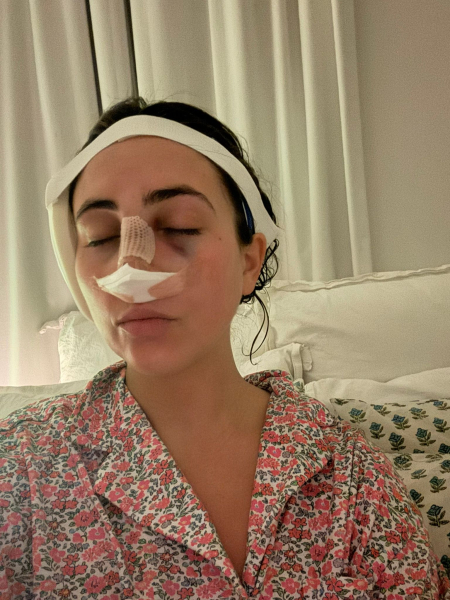
One day after the revision, wearing an ear protector, nose splint, and gauze to catch any blood.
Courtesy Victoria Oliva
My recovery wasn't too bad: I'd give it a six out of 10 on the misery scale. At night I'd take one of the pain pills Dr. Romo prescribed to help me sleep, but other than that the pain was totally manageable with over-the-counter ibuprofen. The splint came off around day five, which was both exciting and nerve-wracking. By day seven, I looked presentable enough for a video call if needed. Since Dr. Romo had used ear cartilage, I wore an ear protector—essentially a padded cup attached to a headband that went around my head to shield the ear from any pressure during the night for two weeks while sleeping.
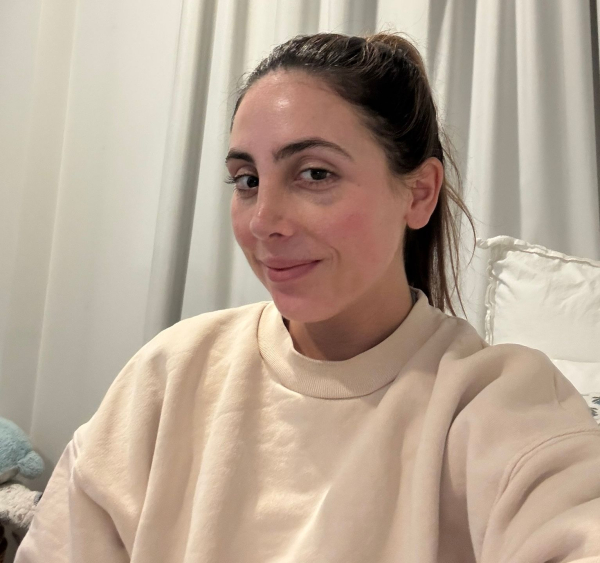
1.5 weeks after the revision, with just color corrector to cover the writer’s black eyes.
Courtesy Victoria Oliva
The post-op care instructions were surprisingly manageable too. I could shower and wash my hair the same day, but had to avoid bending at the waist to prevent bleeding (I squatted instead), and sleep elevated on two to three pillows to control swelling. Easy enough. But then there was the taping. "Taping is critical," Dr. Romo had told me. "This is about controlling how the skin shrinks down to the new architecture." The process is exactly what it sounds like: applying surgical tape across the nose to gently compress the skin and guide it as it heals, preventing excess swelling from distorting the new structure underneath. He recommends taping as consistently as possible, ideally during the day, but at minimum overnight if daytime isn't feasible. I taped for about three months—well past the one month Dr. Romo said I could stop—because I noticed my nose looked noticeably less swollen in the mornings after taping the night before. Honestly, I still tape occasionally before a big event , and am very happy with how my nose healed. I also used my TheraFace Mask Glo (a red light therapy mask I’d already been using consistently for about a year and found kept puffiness down) in hopes of reducing inflammation in my nose, and made sure to get plenty of rest.
“Recovery after revision rhinoplasty generally requires a bit more patience than the initial procedure,” says Dr. Rizk. In the early stages, the experience is similar: Patients can expect bruising and swelling for the first one to two weeks, after which they are usually comfortable resuming social activities. “However, because the nose has already undergone surgery, [complete] healing can be slower,” Dr. Rizk says. “Swelling, particularly in the nasal tip, can persist for a longer period due to scar tissue and changes in the tissue planes.”
At my one-week follow-up appointment, Dr. Romo removed the splint and examined my nose carefully, confirming the structure was exactly where we wanted it to be. I knew I still had months of swelling ahead, but the foundation was solid—and that gave me a ton of relief.
The Reality of Revision Rhinoplasty
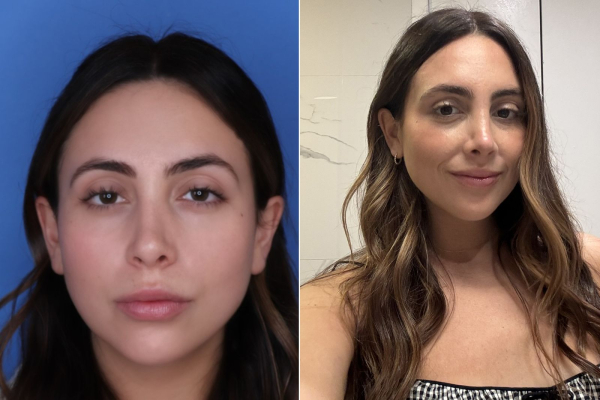
Before (L) and 2.5 months after the revision.
Courtesy Victoria Oliva
While rhinoplasty is a widely discussed topic—especially on social media and reality TV—revision rhinoplasty is rarely talked about, despite being incredibly common. It's one of the hardest surgeries to get perfectly right, and the emotional toll of going through it a second time is so real. That’s why one of the first things I asked Dr. Romo: Could this happen again? His answer was reassuring but honest. The need for further revision after a revision is rare. In Dr. Romo’s practice, the rate of revisiting rhinoplasty for the third time is under 2%, well below the field-wide estimate of 10 to 15%. What made this experience different from my first surgery wasn't just the surgeon, but the approach: structural rhinoplasty focused on rebuilding rather than reducing, a conservative plan tailored to what I actually wanted and a year-long process of monitoring and follow-up rather than a single appointment and a send-off. There are no guarantees in surgery, and healing will always have some variability. But going in informed, with the right surgeon and the right plan, changes the odds considerably.
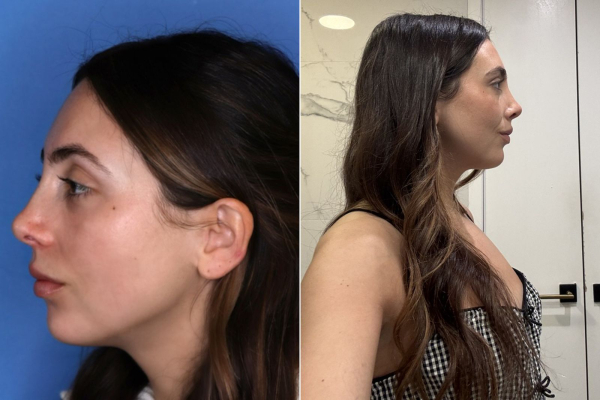
Before (L) and 2.5 months after the revision.
Courtesy Victoria Oliva
For me, this revision wasn't just about fixing what went wrong aesthetically. It was about being able to breathe properly again, about trusting my instincts when choosing a surgeon, and about giving myself permission to prioritize function and form. The decision to undergo a second surgery felt heavier than the first: There was more at stake, more anxiety, and more shame that I had to "fix a fix." But I know now that seeking a revision isn't a failure. It's taking back some control.
Six Months After My Revision Rhinoplasty
I'm now six months post-op, and while I'm still in the healing process, I can see and feel a big difference. My breathing has improved dramatically, and my nose’s asymmetry has been corrected. It finally looks like a refined version of what I'd hoped for the first time around. Most importantly, I feel like myself again: not the version of me obsessing in the mirror, but the version who can look at her reflection and simply move on with her day.
The journey taught me that cosmetic surgery isn't always a one-and-done experience—and that's okay. Getting it right takes patience, research, and a surgeon who truly listens. And sometimes, yes, a second surgery. If you're considering a revision rhinoplasty, my advice is this: Take your time finding the right surgeon, ask every question (even the ones that feel silly), trust your gut, and remember that healing is a journey measured in months, not days. The nose you want—and the confidence that comes with it—is so worth the wait.
Leave a Reply